On this page
- The anatomy of creative problem solving
- How the brain handles novelty and structure
- Architectural Case Study (Filippo Brunelleschi)
- Sensory calibration and practical tools
- The Nothing Phone Case Study
- Building a creative problem-solving system in companies and startups
- Define the problem before designing a solution
- The paradox of productive constraints
- From individual ideas to group decisions
- Psychological safety and high standards
- The anatomy of an unorthodox solution: lessons from modern engineering
- Practical habits for developing creative capacity
Creativity is often described as something mysterious: a sudden flash of insight, a solitary genius, or an idea that appears from nowhere. Looking at creativity through originality, effectiveness, and context makes it easier to understand. A useful idea needs a clear way to fail. Without one, you are guessing rather than testing an innovation.
Originality matters, but novelty alone is easy to produce. You can combine random elements and call the result new. For me, creativity means looking at a familiar problem from another person’s point of view until a neglected solution comes into view. It means changing lenses: stepping outside your own assumptions to understand what people need, then using that understanding to build something new with measurable value.
For founders and engineers, creative ability shows up when they turn severe constraints into a mechanism that works in the real world. A wild concept is easy to imagine in an empty room. Making an idea work within physical, financial, and operational limits is harder.
The anatomy of creative problem solving
A useful starting point is a clear definition. Mark Runco and Garrett Jaeger describe creativity as requiring two things: originality and effectiveness. An idea that is original but useless is an eccentricity. An idea that works but follows standard practice is routine execution.
| Dimension | Cheap originality | Functional creativity |
|---|---|---|
| Starting point | A desire to look clever or different | A concrete, neglected point of friction |
| View of limits | Treats constraints as creative blocks | Uses constraints as structural scaffolding |
| Evaluation method | Subjective appeal and novelty | Measurable user utility and performance |
| Primary risk | Wasted capital on unworkable novelties | Incremental drift toward the familiar |
| Failure condition | The idea cannot be tested or falsified | The test proves the underlying assumption wrong |
Context determines whether an original, effective idea is useful. An algorithm that advances a theoretical optimization problem may matter in computer science. In consumer software or hardware, the same algorithm can be a poor choice if it adds two seconds of latency or drains a phone battery.
Morris Stein (an influential mid-century psychologist who was among the first to formalize how social groups validate novel ideas) pointed out decades ago that a work is only recognized as creative when a relevant group accepts it as useful or tenable at a specific point in time. Novelty without social or operational utility remains an isolated exercise.
Psychologists Ronald Beghetto and James Kaufman describe four practical levels of creativity:
- Mini-c: Personal interpretations or insights that help someone learn a concept.
- Little-c: Everyday problem solving, such as repairing a broken mechanical latch with household wire.
- Pro-c: Professional expertise that allows an engineer or designer to make original contributions within a field.
- Big-C: Historic breakthroughs that redirect an entire discipline, such as the development of the transistor at Bell Labs.
Business leaders often assume they need Big-C genius to survive. In practice, early-stage companies and engineering teams depend on disciplined Pro-c work and steady Little-c adjustments. You do not have to rewrite the laws of physics every morning. You need to find where existing practice fails the person using your product.
Look at the annual Red Dot Design Awards. Across industrial equipment, consumer tools, and furniture, many winning entries rely on existing technologies. Their designers have noticed details that competitors overlooked. A medical monitor that lets an exhausted night-shift nurse read critical measurements from five meters away, without glare, is a good example. Its value comes from close attention to how the equipment is used.
Invention and innovation are often confused. Invention means creating a new device, compound, or technique. Innovation means putting an idea into practice in a way that creates sustainable value. You can fill a notebook with interesting mechanisms, but the real test begins when an idea meets customer habits, manufacturing costs, and regulatory requirements.
How the brain handles novelty and structure
Popular psychology spent years dividing creativity into a “right brain” and logic into a “left brain.” Neuroscience has challenged that simplified picture. Creative work does not depend on shutting down analytical thought and letting impulses take over.
Brain-imaging research, including studies led by researchers such as Roger Beaty, suggests that creative thought depends on coordination between three large-scale brain networks:
- The default mode network: involved in retrieving memories, mentally simulating situations, and making spontaneous associations.
- The executive control network: supports working memory, keeps goals in view, evaluates ideas, and helps inhibit deliberate responses.
- The salience network: identifies potentially important connections and helps shift attention so the executive network can evaluate them.
When people are new to brainstorming, they often fall into one of two patterns. They judge each idea too early, before promising associations have time to develop. Or they generate a long list of unusual ideas without checking whether any can work in practice.
Experienced problem solvers move between exploration and evaluation. They first generate options without judging them, then examine the strongest candidates carefully. In 1926, Graham Wallas described a similar process in four stages: preparation, incubation, illumination, and verification.
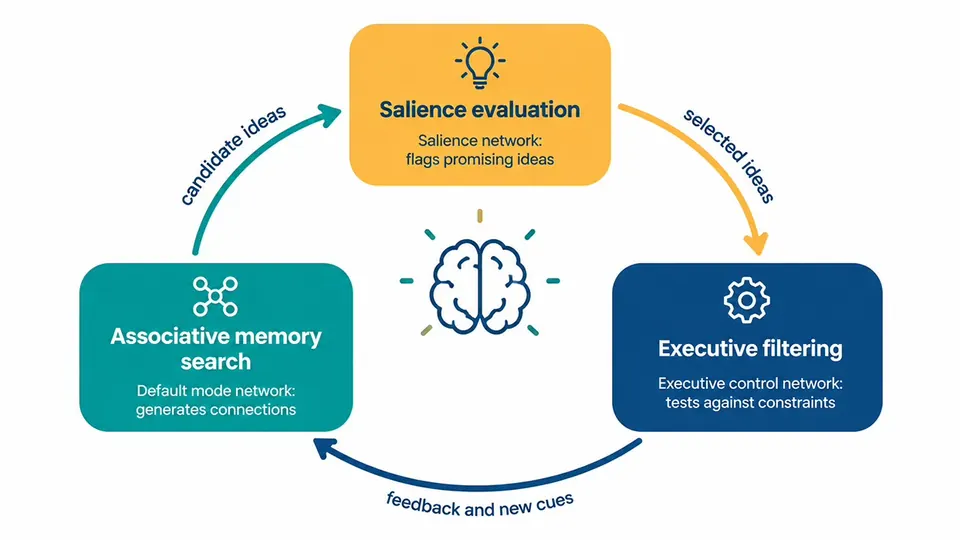
Preparation is easy to underestimate. You cannot combine concepts you do not understand. During incubation, your mind continues working on a structured problem while your conscious attention rests or shifts to a low-demand activity. Illumination is the moment a possible solution becomes clear. Verification is the work of checking whether it actually functions.
A 2021 experiment on creative incubation by Sophie Schwartz and her team found that brief periods of light N1 sleep increased participants’ chances of discovering a hidden rule in a number-reduction task. Participants who hovered at the edge of sleep were nearly three times as likely to spot the pattern as those who stayed awake, provided they had already spent time working on the problem.
Incubation has little to work with if preparation is skipped. Meaningful associations draw on domain knowledge, observed points of friction, and the physical limits of the problem. Without clear constraints, thought can circle through familiar memories and whatever has recently occupied your attention.
Architectural Case Study (Filippo Brunelleschi)
I know a very good example: history offers clean proof of how rigid physical boundaries force genuine creativity. In 1418, the city of Florence faced an impossible architectural dilemma with the Cathedral of Santa Maria del Fiore. The central octagon was forty-four meters wide and sat fifty meters in the air. Traditional Gothic vaulting required massive temporary wooden frameworks called centering to hold the masonry arches until the keystone locked them together. But Tuscany did not have enough timber to build a scaffold that tall, and buttresses were banned by city rules.
The goldsmith and architect Filippo Brunelleschi solved the deadlock not by demanding unfeasible materials, but by redesigning the physical system around the limitation. He proposed building the dome with no supporting wooden framework from the floor.
To make that possible, Brunelleschi used an inner and outer shell to minimize dead weight. He embedded horizontal stone, iron, and oak tension rings to counteract lateral hoop stress like barrel bands. Most importantly, he directed masons to lay more than four million bricks in an interlocking herringbone pattern, angling each vertical brick to act as an immediate wedge that locked the horizontal courses in place row by row as they climbed.


When normal lifting devices could not haul heavy sandstone beams up to the vault, he invented a three-speed reversible hoist driven by a single team of oxen. Every single component was an operational answer to a hard constraint. The result remains the largest unreinforced masonry dome ever constructed.
Sensory calibration and practical tools
When you reach a conceptual dead end, staring harder at a screen rarely changes the way you think. Your environment shapes the information available to you. When the inputs stay the same, your thinking can keep returning to the same paths.
I keep a set of nine story dice on my desk. Each die has simple icons on its faces, including an anchor, a clock, a tree, a key, an open book, and a lightning bolt. I bought them years ago as a storytelling tool for teenagers. They work well as a way to help young people connect unrelated objects, characters, and events into a coherent story.

Pairing two unrelated symbols gives me a way to step outside the usual framing of a problem. It can interrupt a familiar line of thought and suggest another angle to explore.
Sensory calibration is another useful practice. Much of our work happens through abstract language and flat digital interfaces, which can narrow what we notice. Deliberately using all five senses can make it easier to spot details and sources of friction.
- Visual calibration: Study how other fields manage density, hierarchy, and color. Architectural blueprints, aerospace cockpits, Japanese printmaking, and products in the Red Dot catalog all offer examples of how to direct attention without adding clutter.
- Auditory calibration: Listen closely during customer interviews. Notice the phrases people repeat, their pauses, and the sighs that appear when they describe a workaround. A change in tone can reveal frustration that never makes it into a support ticket.
- Tactile calibration: Physical materials have practical properties that shape how an object feels and performs. Weight, surface friction, and thermal conductivity can influence whether a product feels reliable. Even in software work, keyboard feel, mouse resistance, and desk ergonomics affect comfort and work rhythm.
- Olfactory and gustatory observation: In food development, small changes in taste or scent can alter the balance of a dish. Learning to notice these subtle differences builds the habit of catching small discrepancies before they become larger problems.
When I face a complex systems problem, I often turn to mind-mapping software such as WiseMapping. Its hierarchical node trees let me divide a large, intimidating objective into smaller branches.
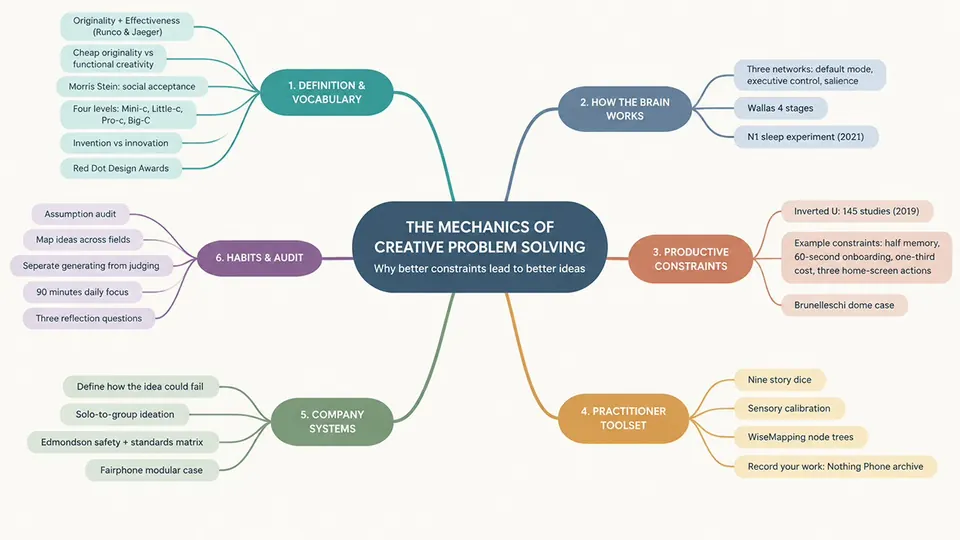
A visual map can expose links between ideas that usually sit in separate mental categories. It can also reveal missing pieces, fragile dependencies, and places where one change could solve several related problems. I can zoom out to view the system as a whole, then inspect an individual node without losing sight of the wider structure.
The Nothing Phone Case Study
In my opinion, a related habit that sharpens creative ability is keeping a strict record of what you make. After you wrap up a difficult working session, document the exact output before closing your desk. You might take snapshots of physical mockups, keep a dedicated sketchbook, or collect working drafts in a dated journal. The simple habit of tracking where you started and where you ended allows you to spot recurring patterns, blind spots, and real forward progress over time.
This kind of deliberate recording works just as effectively for design teams. A clear example occurred during the development of the Nothing Phone (1) and its transparent wireless earbuds. When the design team, led by design director Tom Howard, began outlining their hardware direction, they did not start by guessing what might look futuristic in isolation.
Instead, they methodically collected, inspected, and documented nearly every notable, unusual, and creative phone and audio product in industrial history. They analyzed how form factors evolved across different technology cycles and tracked the exact ideas earlier industrial designers tried to express.
You can check his words here: https://www.youtube.com/watch?v=mxhbTsHrCvc
Howard’s team assembled this historical research into a dense physical reference book for the company. That archive allowed them to spot unexamined industrial tropes and revive neglected concepts, like visual transparency and surface mechanical textures. By grounding their ideas in an exhaustive physical record of the past, they produced an original device with its glyph interface and clear rear glass that stood out against a sea of identical aluminium rectangles.
Building a creative problem-solving system in companies and startups
Many companies undermine creativity through processes meant to encourage it. They set up suggestion boxes, hold annual hackathons, and bring in consultants for sticky-note workshops. Yet when an engineer suggests a change that threatens an existing quarterly metric, management may block it.
Startups and technical teams need a reliable way to test ideas. Occasional bursts of enthusiasm are not enough. The process should reward disciplined experiments and make it difficult for untested assumptions to pass as facts.
Define the problem before designing a solution
Creative work often goes wrong at the problem-framing stage. Teams start building features before checking whether the problem is real, frequent, or painful for the people experiencing it.
Before anyone writes code or builds a prototype, ask the team to describe how the proposed solution could fail. If failure cannot be defined in measurable terms, there is no reliable way to judge whether the work has succeeded.
Start with three questions:
- What specific physical or economic constraint makes the problem difficult for the user today?
- What workaround does the user rely on now, and how much time or money does it cost?
- What assumption must be true for our proposed solution to outperform that workaround?
The paradox of productive constraints
Clear constraints give engineers something concrete to work against. A team with an unlimited budget, endless server capacity, and no deadline can easily produce a system that is bloated and fragile.
A 2019 review of 145 empirical studies on workplace constraints found an inverted-U relationship between limitations and creative performance. With too few constraints, exploration can become aimless. With unreasonable pressure, people become discouraged or cut corners. A manageable set of clear boundaries can push a team past obvious, expensive approaches and toward leaner solutions.
Try imposing a few deliberate constraints on a design problem:
- Cut the memory footprint in half.
- Require onboarding to finish in under sixty seconds on a poor 3G connection.
- Cap the bill of materials at one-third of the incumbent product’s cost.
- Limit the home screen to three core actions.
When money, computing power, or screen space cannot solve the problem for you, you have to reconsider how the product works.
From individual ideas to group decisions
Open brainstorming meetings often perform poorly. Social psychology research has long identified problems such as production blocking, fear of judgment, and social loafing. The most forceful voices can dominate while quieter specialists, including people with valuable technical knowledge, hold back.
Use a process that starts with individual work and brings the group together to evaluate ideas:
- Independent preparation: Send every team member the problem brief and relevant performance data 48 hours in advance. Ask each person to write three to five concrete proposals without consulting colleagues.
- Silent aggregation: Put the proposals in a shared document without names attached. Have everyone read and annotate them before discussion begins.
- Focused convergence: Use the meeting to test how the proposed mechanisms would work, group compatible ideas, and choose which hypotheses to prototype.
- Rapid prototyping: Within three business days, the person advocating for an idea builds the smallest credible test of its riskiest assumption.
This approach makes it easier to judge ideas by their logic, technical feasibility, and fit with the constraints, rather than by the presenter’s seniority or charisma.
Psychological safety and high standards
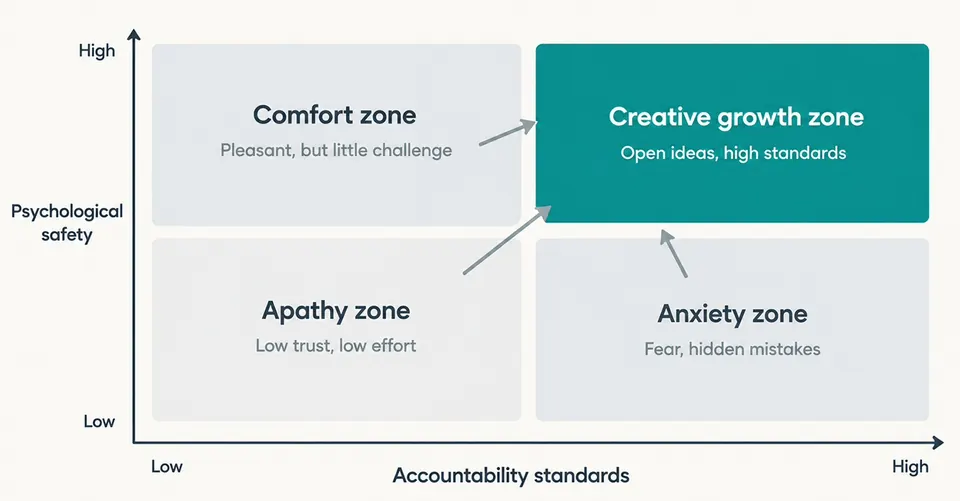
Psychological safety is sometimes mistaken for conflict-free management. Amy Edmondson’s work defines it as a shared belief that people can take interpersonal risks within a team. An engineer should be able to point out a flaw in the founder’s plan without fearing retaliation. A designer should be able to show an imperfect prototype and ask for feedback without being treated as incompetent.
Psychological safety without high standards can lead to comfortable mediocrity. High standards without psychological safety encourage people to hide mistakes until a release fails. Creative teams need both: people must be able to speak honestly, and the work must stand up to demanding evaluation.
The anatomy of an unorthodox solution: lessons from modern engineering
To see how creative problem solving operates under severe market and physical constraints, look at the Dutch hardware company Fairphone.
The global smartphone industry is dominated by massive electronics corporations with multi-billion-dollar supply chains. For over a decade, consumer electronics manufacturers have pursued an aggressive design pattern: glued glass sandwiches, proprietary fasteners, sealed lithium-ion batteries, and surface-mount components that are impossible for an owner to repair. The major players claim that tightly glued unibody designs are the only way to deliver water resistance, drop durability, and slim pocket dimensions.
Fairphone, a mid-size company based in Amsterdam with only a few dozen core engineers, deliberately rejected that industry assumption. They adopted an uncompromising operational constraint: the device had to be modular, ethically sourced, and repairable at home using a standard miniature Phillips screwdriver.
Building a modular phone on a fraction of a giant tech budget creates severe engineering friction:
Connector bottlenecks: Every removable component requires an electrical connector. Traditional push-fit ribbon cables take up scarce interior volume, add weight, and introduce mechanical failure points when dropped. Over four hardware generations, Fairphone’s team engineered custom spring-contact pads that let components communicate through direct compression instead of fragile flex cables.
Thickness and thermal management: Glued phones use structural battery packs and copper heat pipes pressed directly against exterior frames. Fairphone had to design a rigid modular midframe that shields separate, swappable components (like the camera module, USB-C port, and speaker unit) while keeping the overall chassis thin enough for everyday consumer pockets.
Sealed durability without glue: Instead of using permanent waterproof adhesive that destroys the screen when opened, they designed custom elastomer gaskets and compression seals around the perimeter of the swappable modules, earning IP-rated water resistance while keeping the back cover tool-free and easily removable.
Instead of fighting incumbents on marketing spend or cosmetic novelty, Fairphone focused their creativity directly on the friction point of serviceability. Their constraint forced them to invent unique assembly architectures that larger manufacturers dismissed as unworkable. That is multi-lens problem solving applied to consumer hardware.
Practical habits for developing creative capacity
Creative thinking can be practiced. It weakens when most of your time goes into passively consuming information and develops when you regularly produce and test ideas under constraints.
Build these habits into your weekly routine:
- Audit your assumptions: Write down three foundational rules your team takes for granted. Then reverse one and consider how your product architecture would change. What if the software had to work entirely offline? What if a customer had to assemble the hardware using only one hand?
- Map ideas across fields: Choose an industry far removed from your own, such as commercial baking, maritime salvage, or emergency medicine. Study how people there handle bottlenecks or critical failures under pressure. Then look for a way to apply the same mechanics to a workflow problem in your software.
- Separate idea generation from evaluation: For the first thirty minutes of an ideation session, hold back criticism and generate twenty variations quickly, including poor ones. Step away from the desk and take a walk without headphones. Return an hour later and assess what remains against clear criteria.
- Protect ninety minutes of uninterrupted focus each day: Constant Slack notifications and email checks interrupt the working memory needed for complex associations. When attention keeps resetting, it becomes harder to get beyond the most obvious answers.
When you return to your desk, use three questions to review your current work:
- Am I pursuing this idea because it genuinely helps the person using it, or because it makes me feel clever?
- What single constraint could help us remove half the unnecessary complexity from the product?
- What assumption am I defending because of pride or money already invested?
Novelty can be imitated with noise and decoration. Creative work asks you to examine a stubborn problem honestly until a workable mechanism comes into focus. Define how the idea could fail, then use constraints to guide the search.